For three years I walked the same seven hundred meters — Jiangning Road station to the studio — in five minutes. Human average is nine and a half. I never understood my own urgency, only that I moved as though perpetually late for an appointment I could not name.
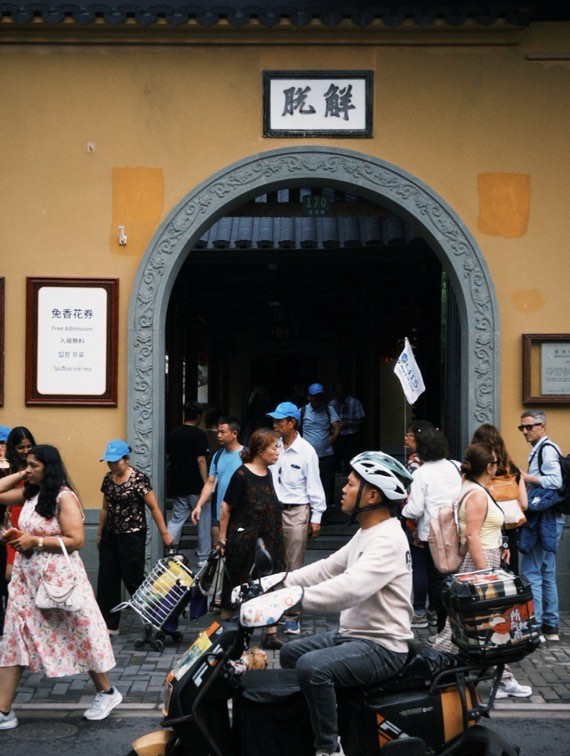
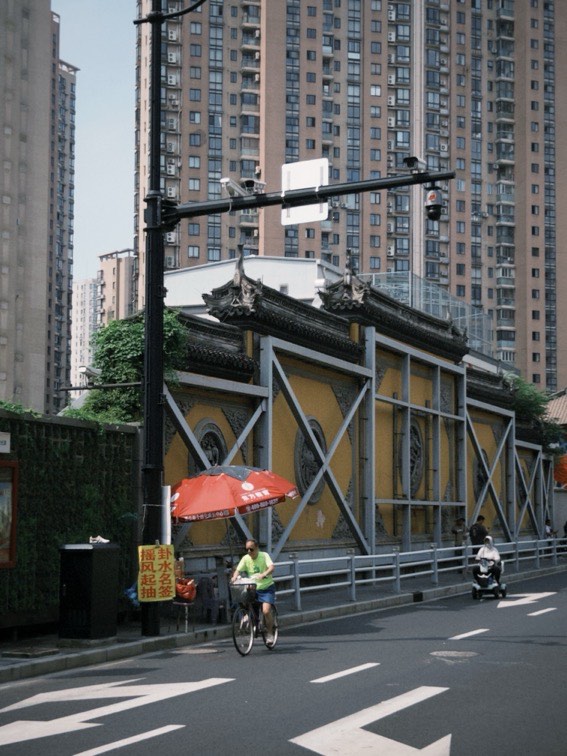
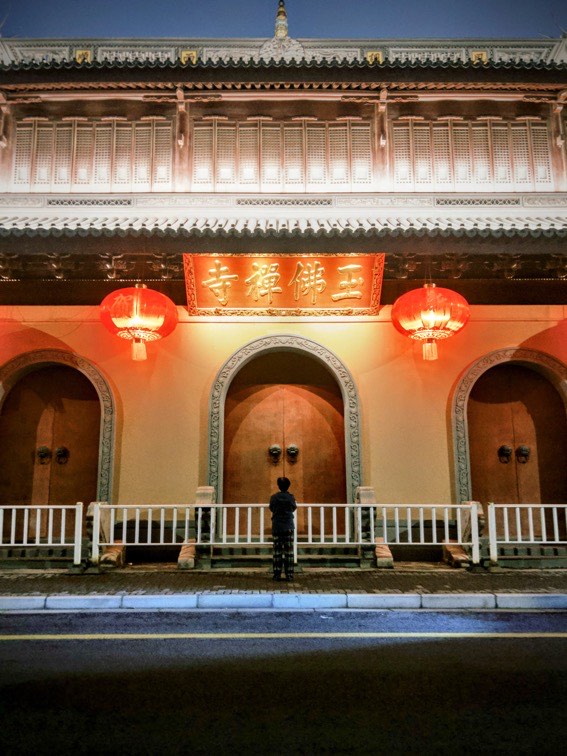
Yufo Temple sits in the right angle where Anyuan Road meets Jiangning Road. It folded into a residential fabric that dates to the 2000s, a thermal anomaly the city forgot to heat.
It is not Longhua, whose incense-stained legitimacy traces — by local legend, generously applied — back to the Three Kingdoms. It is not Jing'an, which plants its gold-leafed, bracket-heavy facade directly against the Apple Store across the road with the architectural confidence. Yufo simply crouches, quiet, ten minutes drive from the commercial centrifuge of the CBD, and maintains, against all urban pressure, a relative stillness.
On the plaque above the entrance, the two characters for liberation — 觧脱 — had watched me pass more than a thousand times.
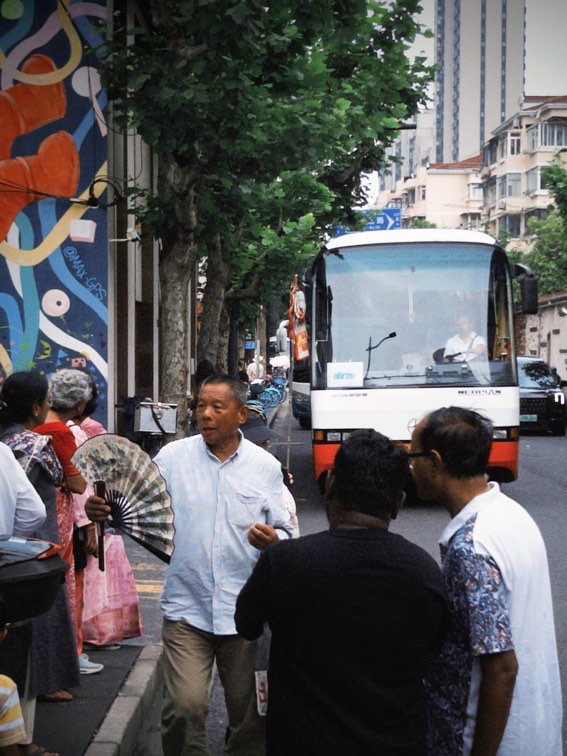
The neighborhood I came to know the way you study a recurring dream — by its internal logic, not its geography. The man selling folding fans operated on a tidal schedule of forensic precision: when a tour bus turned the corner two hundred meters out, he was already standing, inventory fanned, the transaction pre-loaded. His packaging said handcrafted. The word existed only in the copy. Between buses, he squared on the curb and reordered his stock with the patience of a man who has correctly identified waiting as the core competency of his profession.
Three fortune-tellers, ladies in their forties, held the pavement in rotating formation: one under a pink hat sitting across the street, one standing beside the bus stop, one leaning against edge of a construction site of a new luxury resort. Each controlled her quadrant. None encroached. Each morning, in sequence, they advanced on me — Mandarin, Shanghainese, English, a punchy trilingual sales presentation deployed without PowerPoint but with more poise and conviction than I'd seen from any VP in the glass wall office buildings of West Nanjing Road — while I preemptively sealed myself inside headphones before I see them.
I thought they just hadn’t registered me, until there were too many refusals to not recognize me. They were simply waiting for the one morning I would finally crack — waiting for the inevitable collapse of the voluntarist who firmly believes, with the particular arrogance of the secular Sartrean Freedom, that fate is a system he administers himself.
Recently, a foreign pressure arrived the temple. Russian backpackers with Luckin cups jabbered in steppe-calibrated volumes. A Thai tour group carried a cologne I had last came across in Bangkok — something oud cut with lemongrass — and it reacted with the incense in a decadent way that should never have acquired the permit here. Three years prior, the foreigners were just data points. Now, they have colonized three city blocks. The geopolitics of tourism had quietly shifted its center of gravity, and the neighborhood's low-temperature equilibrium was absorbing the thermal load.
Then one morning — I can never reconstruct the atmospheric variable — the system cracked. Not the crack the fortune-telling ladies had bet on. What failed was structural: the grotesque disproportion of it all—tour buses jammed at the curb, passengers who had flown ten, fifteen hours to stay, for twenty minutes, at a place I had believe I held all the rights in the world to ignore. The thought arrived as a sudden fracture in a load-bearing wall, revealing the existence of an entrance not so much as a gate as a question that cuts to the heart of existence: what happens if, at this very moment, you let go of every claim upon your next moment?
I walked in.
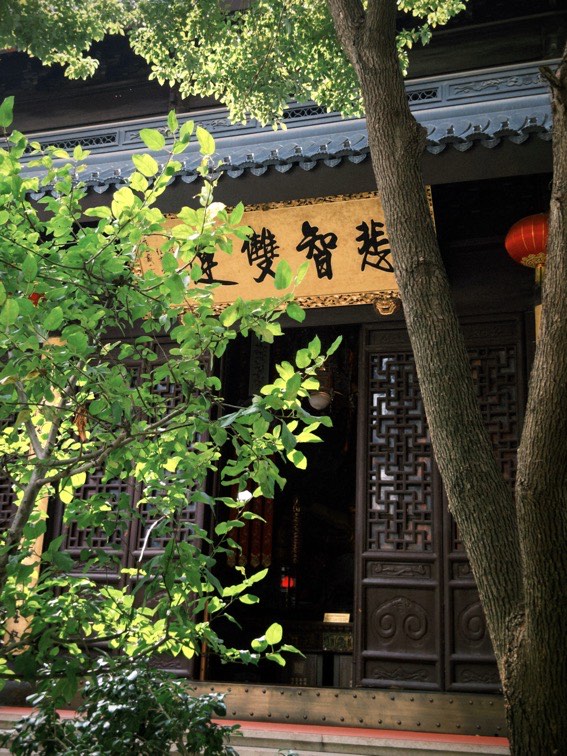
The temple, whose purpose is liberation from attachment, found itself at the center of an increasingly efficient market. The irony is not available for comment but the renovation feels like a press conference: new lacquer on old timber, stone pavers laid with the conscientious regularity of municipal infrastructure. Tour groups murmured at a volume that was technically controlled and functionally not. Women in white linen saris and LV Monogram denims shared the narrow floor, while bodies stood and knelt in contradictory directions, feeding incense into one airspace. The Buddha, carved from Burmese white jade, sat in meditation above the assembly, its surface holding the particular luster of stone that has been looked at for a very long time.
From St. Peter's to unnamed mountain shrines in southern Zhejiang, I have stood before sacred things and understood that an exchange was occurring without being able to identify the currency. I never know what to ask for. Standing before the Buddha, I found this incapacity unchanged.
Some gave. Some asked. Some confessed towards relief. Some lied to make a living. An old man who exited turned around, bowed deeply in the middle of the road, folding himself into an angle of genuine humility — then turned again and looked back before boarding the departing bus, as though checking whether the gesture had registered. Whether that constitutes belief is a question I can only ask without answering.
After the tourists drained away each evening, the street outside went quiet in a specific way — not empty, but voided. An old woman in her sixties appeared at the closed gate with the regularity of a standing appointment. Two plastic bags, clothes and miscellany. She rested against the doorframe, her mouth shut, her eyes holding the particular exhaustion and fixity of someone who has already asked every single question in the world.
The temple does not run a shelter; the Buddha does not offer after hours. But she had and wanted nothing. She was, from my observation across all aspects, closer to the two characters written on the plaque than anyone who had paid additional thirty RMB on the premium incense during the business hours.
Tomorrow I will walk the same road. The headphones will carry no music. The three fortune-tellers will advance in sequence. The fan seller will be watching the corner.
And the two characters will hold their position — waiting for the next soul who finally lets go.
Liberation