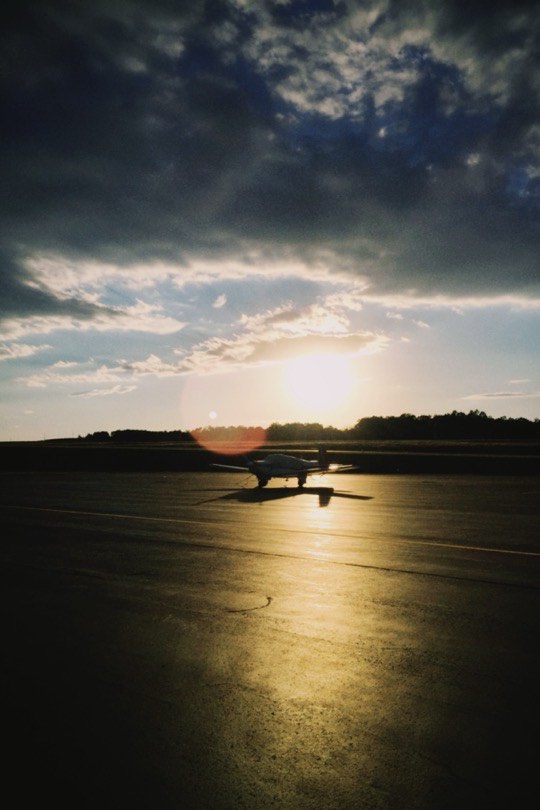
On a sunny spring afternoon in 2015, I landed a Cessna 172 Skyhawk on Runway 3 at Charlottesville Albemarle Airport — alone, for the first time. Stepping out of the cockpit, I had to lean against the fuselage just to stay upright. My legs had forgotten what solid ground felt like.
I had started flying at nineteen, as an international student, already one hemisphere removed from everything familiar. Adventure, apparently, has a compounding interest rate. Weeks before my birthday, I called my mother over Skype and told her what I wanted: a flight training package at a nearby airport. She did not see it coming. I count that as a point in my favor.
My instructor, Ty, arrived at the ramp in a Jaguar wearing aviator glasses, a man in his seventies who flew purely for the pleasure of it. He looked, without irony, like a Hollywood casting director's first draft of a pilot. The 100LL aviation fuel hit me before he said a word — that particular blend of hydrocarbons and aspiration that I have never smelled anywhere else. I felt something in my chest rearranged itself permanently.
The aircraft was a half-century-old Skyhawk — a machine old enough to have its own anxieties. I eyed it from the ramp and thought, with genuine uncertainty: I hope these particular metals hold together at altitude. They did. They always did.
My first flight with Ty was a controlled disaster. Twenty-knot gusts worked the airframe like a carpenter testing a joint. Inside the cockpit, Ty remained a study in applied serenity — narrating the instrument panel, walking the rudder pedals, adjusting yoke and trim and throttle with the unhurried precision of a man who has long since made his peace with turbulence. I, meanwhile, had voluntarily surrendered the controls and was engaged in a private negotiation with my own stomach. I lost thirty minutes of my life to that negotiation. I did not, crucially, ruin Ty's shearling jacket.
We landed back on Runway 3. That flight was miserable. I was nauseous, terrified, and utterly overwhelmed. And that is exactly why I fell in love with it.
Learning to fly gave me a new geometry of the world. Few coordinates on Earth resolve with the same clarity as the Long Island coastline at sunset seen from 1,500 feet, or the Shenandoah ridgeline at 9,000.
But it is the landing that owns me completely. In those final seconds of approach — speed decaying, runway expanding, the aircraft balanced at the edge of its own aerodynamics — I enter a state that I can only describe by analogy: the cardiologist's hands inside the chest cavity, the tennis player reading a 120-mph serve, the floor trader in the half-second before the opening bell. Every variable converges. Every variable demands an answer. I am more alive in that moment than at almost any other.
The license was only rewarded after finishing the entire syllabus: strategic planning, calibrated risk, the precise grammar of radio communication, the discipline of balancing power against speed. Instrument flying teaches you that you cannot always trust what you see — only what the instruments confirm. It turns out this is also a workable philosophy for living in New York, or Shanghai, or anywhere the weather is instrument meteorological conditions and the visibility is effectively zero.
After graduation I moved away from Runway 3. In the years that followed, I kept encountering versions of that first turbulent flight: moments that were chaotic, disorienting, and larger than my current competence. Each time, I found myself reaching for the same correction. Stay in the left seat. Work the instruments. Do not surrender the controls.
In the spring of 2021 — six years after that first solo — I started writing. The first entry felt, with suspicious precision, like a touchdown: the moment before the you feel the ground, when commitment has been made and there is nothing to do but land. So I named it Runway 3. Since then, I have logged over 100,000 words. A journal, like a logbook, is a record of where you have been and evidence, however provisional, that you stays alive.
Runway 3