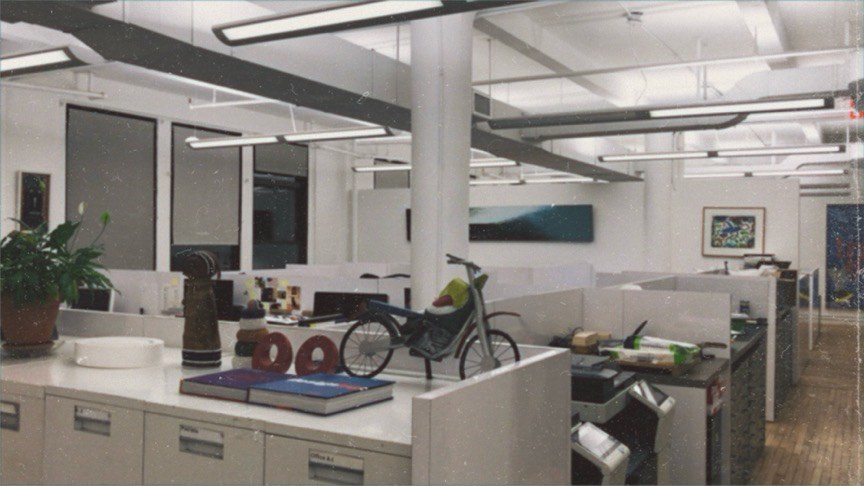
I arrived more than an hour early. The F train from Brooklyn to West 24th Street was the same commute I had made to grad school for two years, so the morning carried that particular unease of familiar geography dressed in unfamiliar stakes. I stood outside the glass door at 7:30 AM, peering into the dim studio like a naturalist observing a habitat before entering it, cataloguing what I could see: a large presentation wall studded with push-pins and critique prints, a walk-in cabinet of stationery arranged with the logic of a surgical tray, a printer positioned at the center of the floor plan with the authority of a load-bearing column. The 1,000 square feet of Chermayeff & Geismar & Haviv occupied a pre-war building on the Chelsea-Flatiron seam, and every inch of that layout had apparently been subjected to the same ruthless economy as the logos produced inside it. A little bigger and you waste space. A little smaller and you feel crowded. The office was its own argument.
Scott let me in. I found a desk, opened random windows on an empty iMac screen to perform competence for an audience of no one, and waited.
The phone rang before 9.
The voice on the line was firm, slightly hoarse, and carried the compressed urgency of someone for whom pleasantries are a rounding error. Sagi Haviv, calling from a business trip, welcomed me with a single question: did I know After Effects? I had not used After Effects. The closest I had come was a Flash animation in third grade — a blue rectangle morphing into a red circle, which felt, in this context, like listing a crayon drawing when asked about oil portraiture. I said yes. He told me to animate every logo the firm had produced since 1957. He would review the work on Wednesday.
I hung up and stared at the desk.
The job description, which had not existed, had not mentioned After Effects. But the operative logic of the place was already legible to me: a person hired here was expected to be proficient in any instrument design might require, or to make themselves so before anyone noticed the gap. I printed every logo in the firm's archive and pinned them to the walls of my cube in a constellation that, from certain angles, resembled the evidence board of a detective who had just run out of wall. I watched tutorial videos until the terminology stopped sounding foreign. By Wednesday, I had something to show.
Sagi returned mid-week. I will not pretend I had fully decoded him by then, or that I ever entirely did. He arrived at 9 AM each morning and immediately pressurized the studio — moving through the small space in rubber flip-flops, the slap of each step on creaky wood serving as a real-time location broadcast, issuing instructions in rapid sequence: a client on the phone, a better stock photo for logo testing, my name called from across the room. His lunch, delivered at noon, routinely went untouched until late afternoon, left cooling on his desk like a proposition he had not yet gotten around to refusing. The creative retreats into his private office — tracing paper, color Sharpies, door closed — arrived without warning and lasted as long as they needed to.
Tom Geismar occupied the adjacent room at a different frequency entirely. Mid-eighties, unhurried, he began each morning with a glass of Ocean Spray cranberry juice over ice, the cubes producing a small, pleasing percussion against the glass as he studied a computer desktop that operated on a taxonomy visible only to him — decades of files layered across a 21-inch screen like geological strata, the physical desk beside it a similar topography of printed logos in multiple directions and iterations, stacked with the geological patience of someone who understood that the right answer was in there somewhere and that urgency was not the instrument for finding it. Had I encountered Tom earlier in life, I would have added him to the private list I maintained — Twain, Jobs, Baldessari — of figures whose cluttered surfaces I planned one day to deploy as evidence against my parents.
What distinguished the studio from every other creative environment I had passed through was not the archive on the walls or the caliber of the clients. The industry likes to talk about "creative vibes" and "disruption." They imagine designers as latte-sipping aesthetes discussing the latest Bottega bag or that trendy ramen spot in East Village. This is not a place where J. Cole is played in the background. Apparently. CGH was a science lab. We didn't "feel" our way through designs; everyone's got their scientist hat on - the passion, integrity, and persistence to get to the bottom of truth.
Scott spent two full days adjusting the kerning of a custom logotype — not redesigning it, not reconceiving it, adjusting the spatial relationship between a small number of letterforms until the optical result matched an internal standard that existed prior to and independent of any grid. The principals once carried a projector aboard a transpacific flight so that a client presentation would render in precisely the colors the work required. The grids used to digitize hand sketches were discarded once the digitization was complete, replaced by incremental naked-eye calibration that continued until the form looked correct rather than measured correctly. The distinction between those two conditions — arithmetically right versus optically right — turned out to be the central epistemological commitment of the place.
This was the methodology: treat every project as an investigation whose conclusions are not known in advance. Ivan Chermayeff had said it plainly in an interview — we have to understand what our clients are, which is not necessarily what they tell us. The work bore this out. Six identical rectangles for Harvard's publishing house. Two serif letters for Armani Exchange, rejected once, defended, accepted. The logos that endured were not the ones that illustrated a client's self-description; they were the ones that diagnosed something the client had not fully articulated and rendered it in a form simple enough to be immediately legible and strange enough to remain worth looking at.
On a Friday night, we spread animal photographs across the meeting room table — red fox, leopard gecko, a taxonomy of creatures assembled for a television network's identity rebrand — ate pepperoni pizza, and worked past midnight studying the structural logic of how living things are built. It was, like most things in that studio, less romantic than it sounds and more serious than it looked.
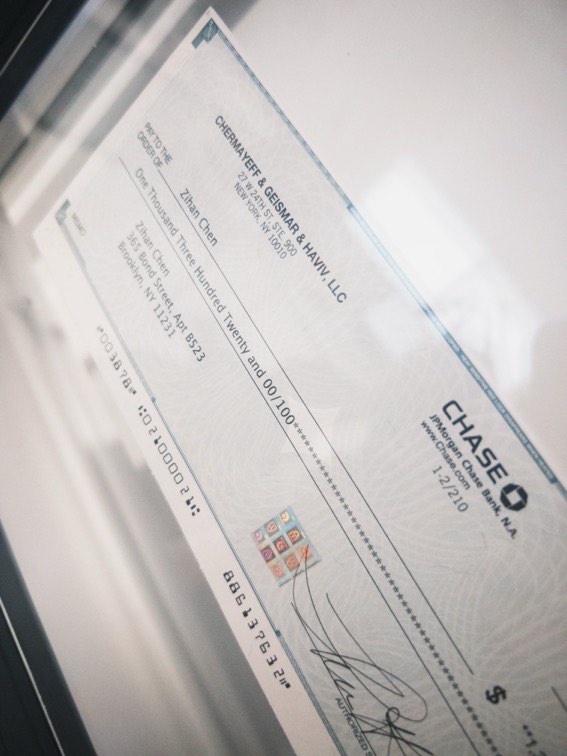
I eventually produced thirty-plus animations for the firm's website, where they remain. I learned After Effects. I cashed a check for fifteen dollars an hour, took the F train back to Brooklyn, and spent what felt like an irresponsible fraction of it on tuna toro, which was correct.
But the ledger of what I received from those four months is not denominated in software skills or animation credits or the minor biographical credential of having worked somewhere with a famous address. What transferred was a way of looking — specifically, the understanding that rigor and curiosity are not opposing forces to be balanced but the same force expressed at different scales. The scientist does not know the answer before running the experiment. The experiment is the point. Every logo pinned to my cube wall was a question someone had refused to answer prematurely.
In a moment when algorithmic tools promise trademark design in two hours for the price of a coffee, and Fiverr has fully democratized the word 'expert,' the scarcest resource in any creative field is not speed or software or even talent. It is the willingness to stay in the problem long enough to find out what the problem actually is.
The printer at the center of the studio floor, I understood eventually, was not placed there for convenience. It was placed there because everything produced in that room had to pass through it — had to become physical, legible at scale, subject to the eye rather than the screen. It was the last checkpoint between intention and reality. Every morning I walked past it on the way to my desk, and every morning it asked the same question the whole studio asked:
Does this actually work, or does it only appear to?
27 West 24th St (2/3: Scientists)