Luck is rarely a lightning strike; it is usually a structural failure in a barrier you’ve been leaning against for a long time.
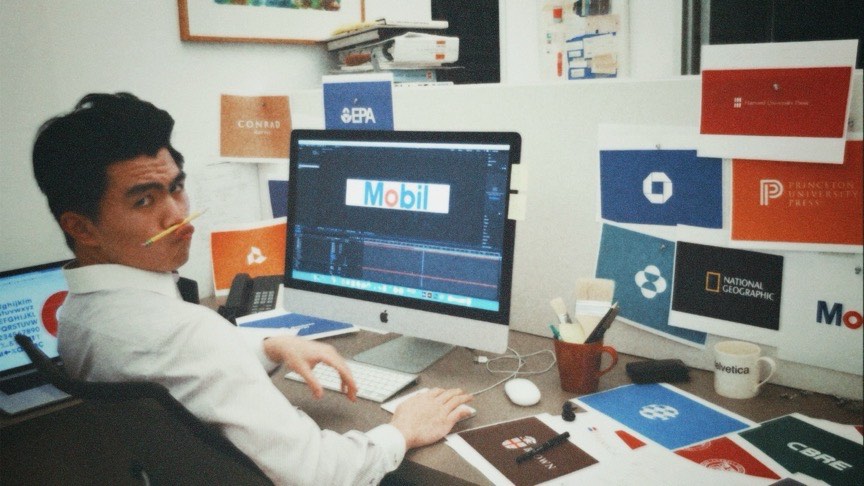
Chermayeff & Geismar & Haviv occupies a strange position in the taxonomy of American design: a firm with fewer employees than a lacrosse team, responsible for the visual grammar of institutions larger than most nations. Chase Bank. National Geographic. The US Open. I found their portfolio on a cozy spring afternoon in 2018, somewhere between my second cup of coffee and my third hour of avoiding a 200-page reading on social justice. The lethargy evaporated. Discovering their office was just around the corner in Manhattan felt like finding a glitch in the simulation.
I was in the first year of an M.F.A. in New York City, which is to say I was waking up at 6:39 each morning with a low-grade headache of ambivalence, riding the F train through its full-body percussion, eating a tuna sandwich from Pret A Manger as a kind of secular penance before class. Graduate school had become a holding pattern. What I actually wanted was the work itself — the obsessive, sleepless, one-pixel-off calibration of something real.
The firm's website listed no job openings. This was, I decided, irrelevant.
I wrote to their project inquiries address. Not the careers page — there wasn't one — but the email reserved for clients arriving with budgets and briefs. My pitch inverted the transaction: rather than commissioning them, I proposed they commission me. Three sentences. An afternoon's worth of drafting for the economy of a telegram. I clicked send.
There is a specific kind of delusion required to survive New York. You have to be a genius at fooling yourself into believing the "unrealistic" is simply "not yet scheduled." My pragmatic friends—mostly high-functioning alcoholics—called it wishful thinking. I called it a prerequisite.
Weeks passed. The applications I had considered safe produced nothing. Then, on a Tuesday that looked like every other Tuesday, a reply arrived: the partners had reviewed the portfolio and wanted to talk.
The video interviews with Tom Geismar and Sagi Haviv exist in my memory as a kind of fever reconstruction. I had ironed the same shirt four times — a shirt that did not need ironing — while rehearsing what I would say about the Coca-Cola work. Two minutes in, my voice began its involuntary seismology, muscles staging a small revolt against the stakes. Afterward I sat in front of the blank screen for twenty minutes, my mind absent except for one clear thought: I would never see these people again.
What I did not know then was that Sagi's own design students, who had been maneuvering toward this internship all semester with the focused hunger of people who have been told it is possible, were also in the queue. A competitive field assembled from people who had been trained, explicitly, to want exactly this.
They chose me.
I have no clean theory for why. Twenty-four international awards mentioned in passing on a resume. A portfolio built with the kind of Webflow compulsion that alarmed my friends. Designs that may have spoken in the silence where my voice shook. Or the simpler, less satisfying answer: the work, accumulated over countless sleepless nights of margin-obsessing and slogan-agonizing, had compounded into something that held its own weight. Hard work is a boring explanation, which is perhaps why it remains so consistently underestimated.
The legend of Chermayeff & Geismar begins, as American legends often do, with a barter economy. Before David Rockefeller arrived to commission the Chase logo that would become shorthand for mid-century corporate modernism, Ivan Chermayeff and Tom Geismar were trading design work for dental care. Sagi Haviv was rejected by Cooper Union after relocating from Israel, applied again, was admitted, then spent years lobbying — with what he later acknowledged was an almost obnoxious persistence — for an internship at the firm. Three years after they finally let him in, he was a partner. In 2013, the masthead changed for the first time in 56 years.
What I observed in their stories, and what I have since recognized in every person I would file under the provisional category of legend — designers, chefs, comedians, athletes — is not genius in the romantic sense. It is a higher threshold for discomfort, combined with an almost constitutional inability to be satisfied with sufficient. They want something good so badly that the wanting reorganizes their behavior at the structural level.
This is, I would argue, a teachable discipline. It is also, in its early stages, indistinguishable from delusion.
My first meal in the United States arrived at a made-to-order sandwich counter, where I could not pronounce the ingredients and spent ten minutes in line studying other customers' mouths as they ordered, rehearsing cheese names under my breath. When my turn came, the words dissolved. I pointed at the stack of provolone and said, to the African American sandwich maker, in a voice of pure desperation: Can I have the white one, please. The students behind me processed this at varying speeds. I collected my sandwich and left with the particular dignity of someone who has just survived a social catastrophe of their own engineering.
I do not even like cheese. But I hate the shape of giving up more than I hate embarrassment, which is the relevant metric.
On the evening I signed the offer letter — Sagi Haviv's signature at the bottom, the first of its kind in my career — a friend took me to dinner at a restaurant of the kind that appends fortune cookies to the bill as a gesture of hospitality that announces, simultaneously, its own limits. I am on record as skeptical of fortune cookies. The aphorisms are grammatically unstable and the cookies taste of nothing in particular. But the strip of paper that found me that night read: Life is about making some things happen, not waiting for something to happen.
I have kept it. In New York, the doors aren't locked; they’re just heavy. You just have to lean until something happens.
27 West 24th St (1/3: Hustlers)